
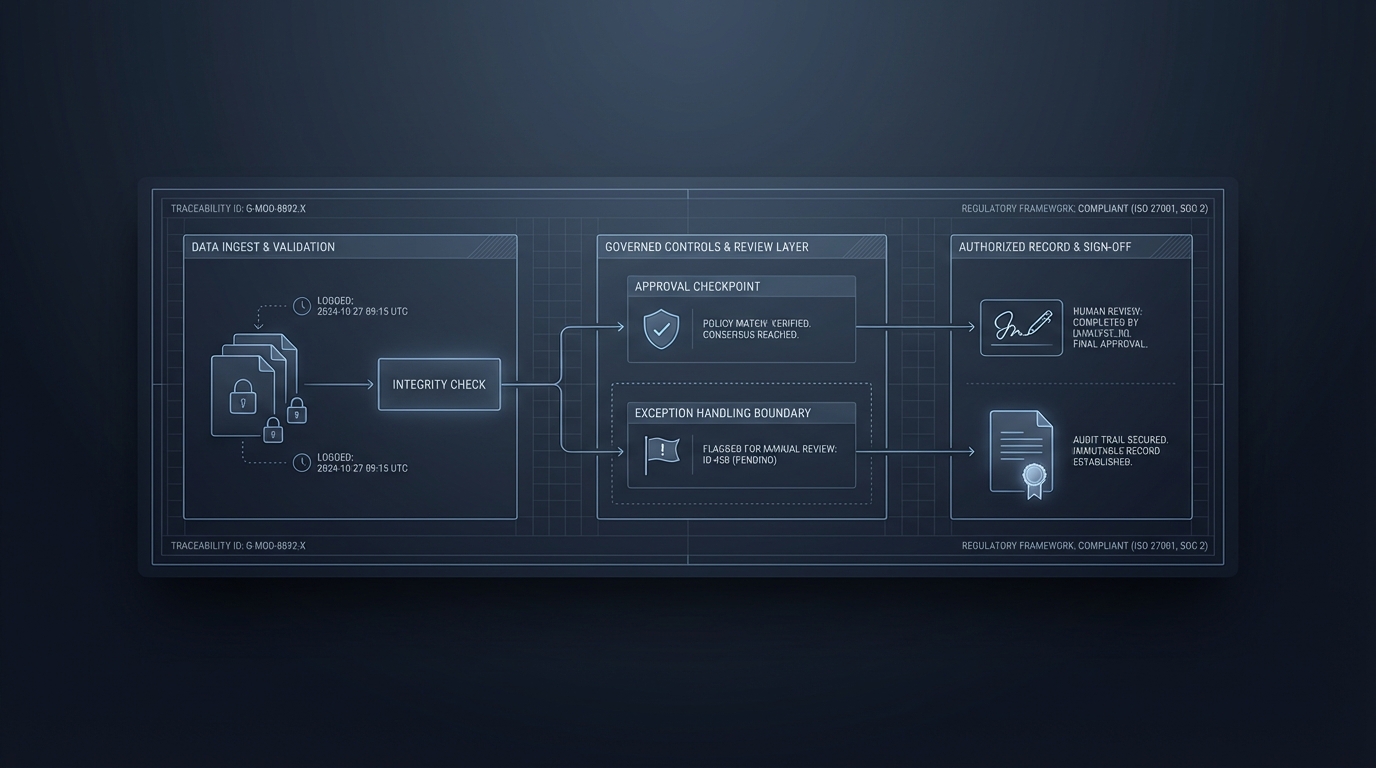
Controls at a glance
The operating controls Plainstep expects to discuss early.
If your organisation has stricter controls or buyer-specific requirements, raise them early and use this page as the baseline reference point.
Governed workflows
Review points for important changes, approvals, and exceptions keep high-impact work from disappearing inside automation.
Least-privilege access
Access to code, environments, and data is limited to named people who need it for the work in front of them.
Traceable delivery
Key changes, approvals, and outputs are documented so clients can challenge what changed, when, and why.
Secure release discipline
Staged delivery, code review, environment separation, and controlled release paths reduce the chance of ad-hoc production change.
Data minimisation
Only the data needed for the task is used, with masking, reduction, or delayed access where full exposure is unnecessary.
Human review where it matters
High-impact outputs remain subject to human judgement, especially where operational decisions or regulated records are involved.

Reviewable outputs and visible approval points
Where AI-assisted or semi-automated work is involved, Plainstep expects review points, rationale capture, and named human ownership to remain visible.

Handling boundaries are defined before work scales
Access, environments, delivery stages, and release paths are discussed early so there is a clear boundary between exploration, staging, and production decisions.
Short answers
The questions buyers normally ask first.
The aim is to give short, explicit answers rather than vague trust language.
How do you review code and change proposals?
Production-facing changes are reviewed before release. Review covers behaviour, data handling, operational risk, and release impact, not only style or syntax.
How do you separate environments?
Development, staging, and production responsibilities stay separate. Changes are checked in staging first, and a production release is a separate decision.
How are secrets handled?
Secrets stay out of source control and live credentials are stored in managed platform configuration or other controlled environment stores.
How is access approved?
Access is granted only to named people with a defined delivery reason, limited to what the work requires, and revisited when the work or risk profile changes.
What release controls do you use?
Plainstep uses staged releases, explicit review before production changes, and traceable deployment paths so clients can see what changed, when, and why.
AI and third-party model use
How Plainstep handles AI-assisted delivery.
AI use is shaped around workflow fit, explicit controls, and client constraints rather than a one-size-fits-all model.
Which AI or model providers may be used during delivery?
That depends on the workflow and client constraints. Where AI-assisted steps are used, Plainstep is explicit about the providers involved and the parts of the workflow they touch before those steps go live.
Is client data used to train third-party models?
Plainstep does not use client data to train third-party models unless a client explicitly asks for that arrangement and the legal, security, and contractual position supports it.
Can AI-assisted steps be disabled for specific workflows?
Yes. AI-assisted steps can be excluded entirely or limited to specific low-risk tasks if the workflow, controls, or client policy require it.
What outputs remain subject to human review?
Recommendations, summaries, exception handling, and any other material output that affects an operational decision remain subject to human review where the consequences matter.
What subprocessors support website, contact, or scheduling workflows?
The public site uses Cloudflare for hosting and Calendly for booking conversations. Additional delivery subprocessors, if any, are discussed in the context of the specific engagement.
Sensitive work
How Plainstep handles sensitive work.
Reduce unnecessary exposure, make handling boundaries explicit, and force human review where the consequences are real.
Data minimisation
Plainstep uses only the data needed for the task at hand and prefers reduced, masked, delayed, or representative data where full exposure is unnecessary.
Retention expectations
Retention is agreed early. Working copies and extracted material do not stay around longer than needed for delivery, review, or agreed record-keeping.
Mandatory human review
Human review is mandatory when work affects production behaviour, regulated records, sensitive outputs, ambiguous cases, or any high-impact operational decision.
What to raise in the first review
- Which systems, environments, and data stores the work needs to touch.
- What access is needed, who should approve it, and how long it should remain in place.
- Which changes require review, sign-off, or release approval before they reach production.
- What logs, evidence, or traceability the client needs to retain for oversight or audit.
- What data should be masked, minimised, delayed, or kept out of the workflow entirely.